Arden Pen Co / Journal / How the last of a great British pen house ended up on my lathe
How the last of a great British pen house ended up on my lathe
The acrylic is the star, and I understand now why Conway Stewart built a reputation on it. It has a depth you simply don't get in ordinary plastic — the light goes into it and comes back changed, the way it does in old celluloid.
I've earned myself a bit of a reputation, over the years, as the chap who makes pens out of wood with a story attached. It started with a Namibian carpenter and a lump of camelthorn, and it rather got out of hand from there. There's flooring salvaged from a builders' yard in El Calafate, turned into a Patagonian collection. There's timber I pulled off a farmhouse that was quietly falling back into the Colorado prairie near Woodrow. There's oak that spent years holding whiskey before it held ink. If a pen can carry the place it came from — a mountain, a barrel, a bog — then to my mind it's no longer just a pen. It's a small, useful souvenir of somewhere real.
So you'd be entirely forgiven for assuming I'd turn my nose up at resin. Plastic. The bright, shiny stuff. And I'll be honest with you — for a good while, I rather did. It felt like the opposite of everything I was trying to do. Where's the story in a bar of acrylic?
And then I came across some Conway Stewart material, and had to eat my words. Two pens came off the lathe today made from it, and I've been turning them over in my hands all afternoon.
A great British name — and an important distinction
If you know your pens, you'll know Conway Stewart. Founded in 1905 in London by Frank Jarvis and Tommy Garner, it spent the best part of a century as one of the great British pen houses — the sort of pens that ended up in the hands of Winston Churchill and half the great and good of the age. Beautiful things. Their finest pieces still change hands for four figures.
Now, here's the part that often gets told sloppily, and I'd like to get it right. The original Conway Stewart company — that hundred-year-old firm — ran into trouble and was placed in receivership back in 2014, and the factory closed. That original company, the one that had been going since Edwardian times, was gone.
The name, though, didn't die with it. A firm called Bespoke British Pens Ltd, based down in Emsworth on the Hampshire coast, acquired the brand out of receivership — led by their managing director Alastair Adams — and they still design, make and sell lovely pens under the Conway Stewart name today. So to be absolutely clear: if you buy a brand-new Conway Stewart, that's who you're buying from — a genuine, proper British pen house carrying the torch with real craft and care, but not the original company that started it all back in 1905.
Which brings me to what's been sitting on my lathe.
The genuine article
When the original company went under, its remaining raw material — the actual resin blanks it had been turning into pens — was dispersed. A good quantity of it found its way to The Turners Workshop here in the UK, and I was lucky enough to get my hands on a proper stash of it.
I want to stress what this is, because it matters. This isn't a reproduction. It isn't new material run off to the old recipe. It's the genuine article — the very resin the original Conway Stewart intended to turn into its own pens, from the original company's own stock. When it's gone, there is no more of it. Ever. That's not a marketing line; it's just arithmetic.
Today's two
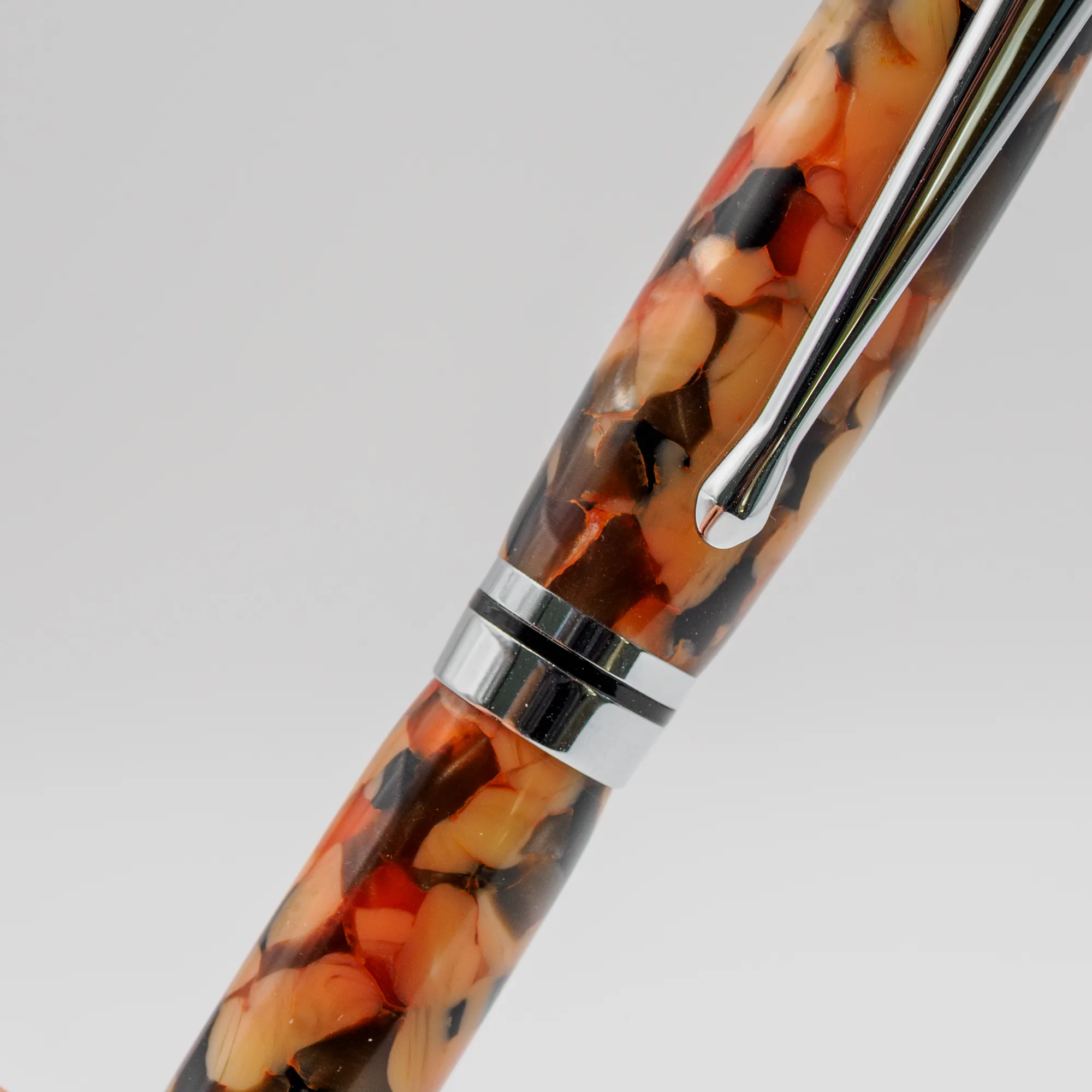
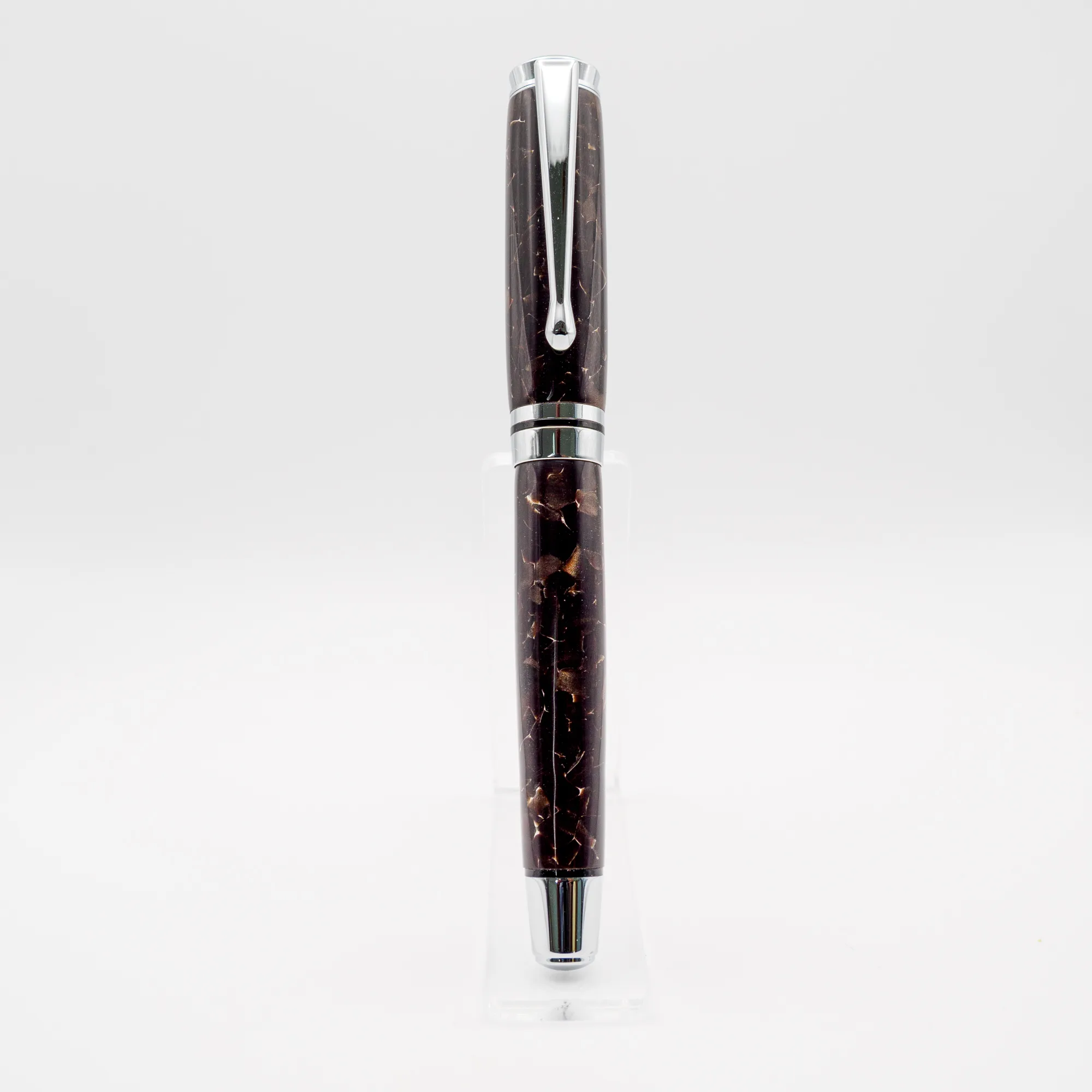
Both are Stratford II fountain pens, finished in chrome with black accents — a deliberately restrained bit of hardware, because material like this doesn't need any help drawing the eye.
The first is Dartmoor, and it's aptly named. At arm's length it reads as almost black, the sort of brown that peat water goes at dusk. Get it under a lamp, though, and the whole barrel opens up — a scatter of tan and pale gold fragments suspended right through the depth of it, catching the light like quartz in wet granite. It's a properly sober pen until it isn't.
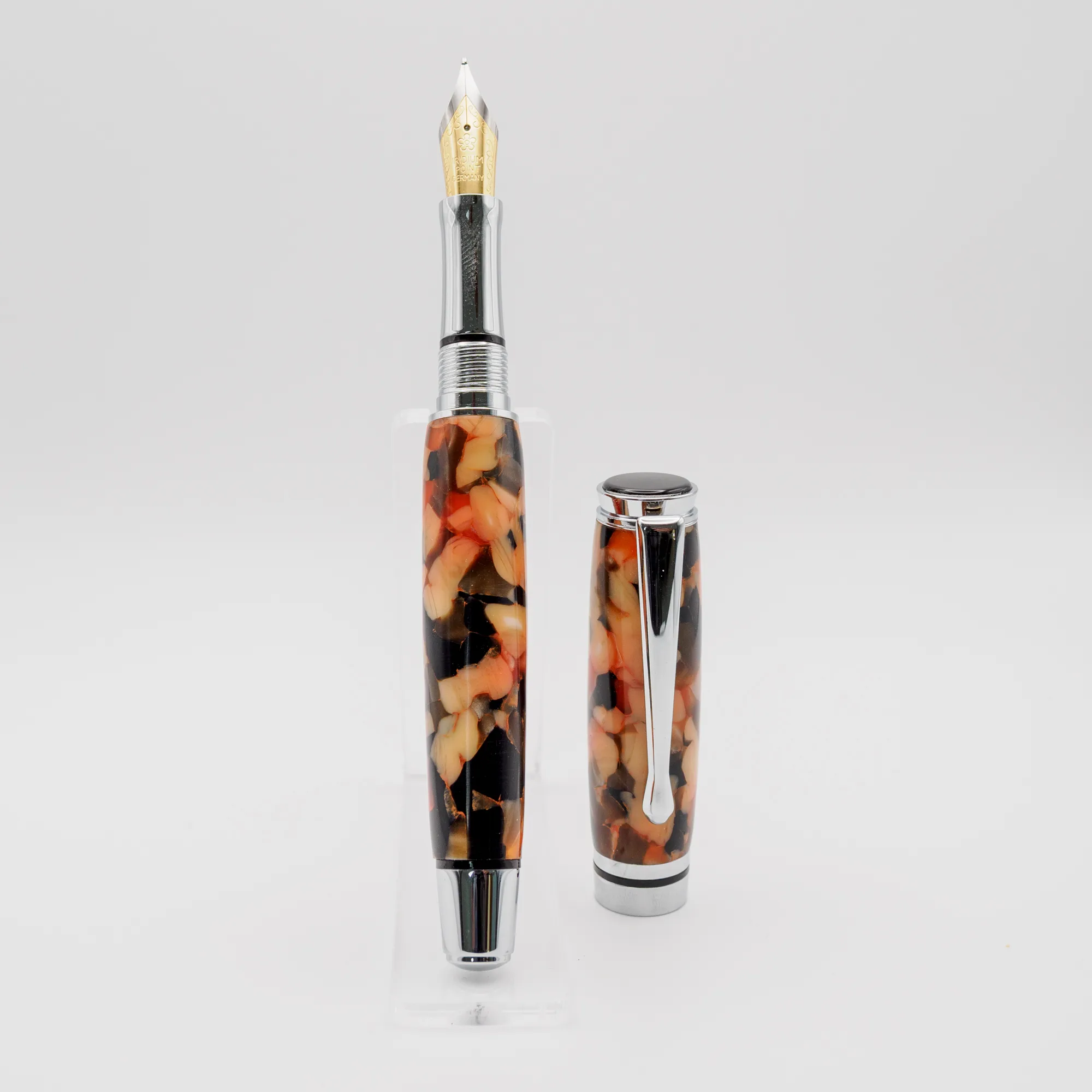
The second is Razorshell, the lighter of the two, and about as far from the first as the same stash could reasonably take you. Warm apricot and cream chips, some of them nearly translucent, packed together with fragments of black between — closer to a shingle beach after the tide has gone out than anything you'd expect from a bar of acrylic. No two turns of it would ever come out alike.
The acrylic is the star, and I understand now why Conway Stewart built a reputation on it. It has a depth you simply don't get in ordinary plastic — the light goes into it and comes back changed, the way it does in old celluloid. It's dense stuff and it demands very sharp tools and a light touch — no bullying it — but the shine it takes off the buffing wheel is something else.
Finite, and all the better for it
You'll have heard me bang on before about fordite — hardened car paint, no longer made, every scrap of it a fixed and unrepeatable slice of history. This Conway Stewart material scratches the exact same itch for me. It's finite. It's tied to a real, named, genuinely important British maker. And once my stash runs out, that's the end of it.
So it turns out I was wrong about resin. Not all of it, mind — most acrylic is still just acrylic. But this? This is history you can hold, and write with. Which, when you think about it, is the whole point of everything I make.
Commission
Build the spec, and I’ll quote it
Pick the pen, the fittings, the plating and the material — including your own timber if you’ve got something with meaning to it. Takes about two minutes, and there’s no obligation at the end of it.
- 01 Pen type and model
- 02 Plating and accents
- 03 Material and species
- 04 Presentation case
- 05 Your notes and details